
Home / By room / Gardens & Pools
Gardens & Pools lighting: The complete guide
At night, a softly lit garden becomes an extension of the majlis: trees lit from below, clear pathways, and a pool that glows from within. The common mistake is turning it into an airport runway.
Recommended values
Guide values; the final design depends on the space, its colours and its use.
Three jobs for light in the garden
- Beauty: highlighting trees, palms, walls and water.
- Movement and safety: clear pathways, visible steps, lit entrances.
- Seating: warm, dim light around outdoor seating areas, not floodlights that dazzle the people sitting there.
Trees and palms
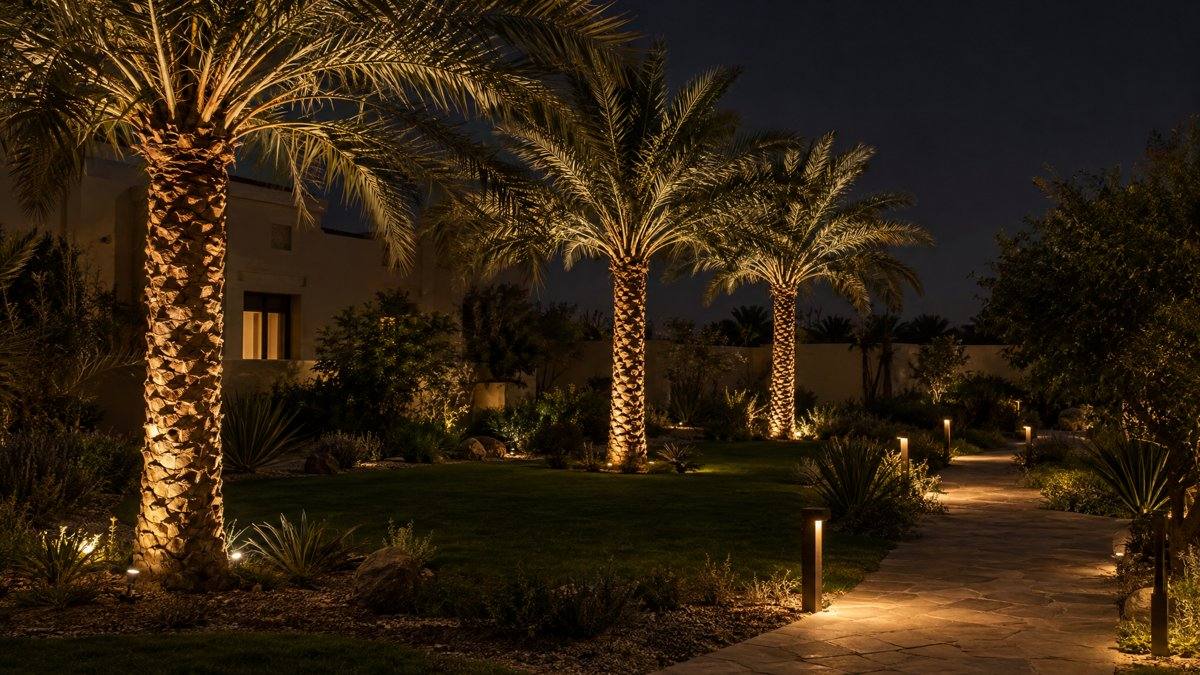
As a rule, trees are lit from below, upwards, because this reveals the trunk and canopy and casts beautiful shadows on the wall behind. The number and position of fittings depend on the tree’s size, the density of its branches and its location: one fitting from the side for a small tree, two or three around a large, dense tree, and sometimes from above for trees that are seen from underneath.
A fitting close to the trunk brings out its texture, while one further away lights the whole canopy. Palms need a narrow beam on the trunk and a wider one on the fronds. A Spike spotlight is better than a fixed one because it can be moved as the tree grows.
International landscape techniques, explained
| Technique | The idea | Suits |
|---|---|---|
| Uplighting | A fitting at the base lighting upwards | Large trees, palms, sculptures |
| Moonlighting | A fitting high up in the tree lighting downwards through the branches, drawing moving shadows on the ground | Seating areas and pathways under large trees |
| Shadowing | A fitting in front of the plant throws its shadow onto a wall behind it | Distinctively shaped plants near a wall |
| Silhouetting | A fitting behind the plant lights the wall, so the plant appears black in front of it | Cacti and architectural-form plants |
| Grazing | Close light that brings out the texture of a trunk or stone wall | Palm trunks, stone walls |
| Wall Washing | Soft light on a garden wall as a backdrop | Internal boundary walls, walls behind planting |
Rules from landscape designers
- Include the trunk in the beam when lighting the canopy, or the tree will look as if it is hanging in mid-air.
- With dense trees, place the fitting outside the edge of the canopy’s shadow so the light reaches the surface of the leaves, not just their undersides.
- A large tree is lit from two opposite sides to soften harsh shadows.
- Palms: a beam angle of 15° to 25° aimed at the fronds, plus a close fitting grazing the trunk if you want to bring out its texture.
- Choose a low-voltage transformer with about 20% spare capacity, because gardens grow and fittings get added.
- The higher a fitting sits in the tree and the deeper it is among the branches, the less light reaches the ground and the more dramatic the shadows.
Pathways and bollards
Short lighting posts (Bollard) range in height from about 35 to 120 cm, and the spacing between them is set by their light distribution and height, usually 4 to 5 m. Ideally their light is directed at the ground so it doesn’t dazzle people walking.
Softer alternatives: low wall fittings set into pathway walls or planters, a concealed strip inside the planter edge, or neon flex along pathway edges. The height of the fitting changes the effect: the lower it is, the closer the light stays to the ground and the less glare it causes.
Outdoor seating areas
A seating area needs warm light from a low level or hidden in architectural details: under the seats, inside the pergola, or dim pendants. A powerful floodlight fixed on the wall above the seating turns it into a work yard. Add light on the surrounding trees too, so you don’t feel you’re sitting in a pool of light in the middle of darkness.
Pools and fountains
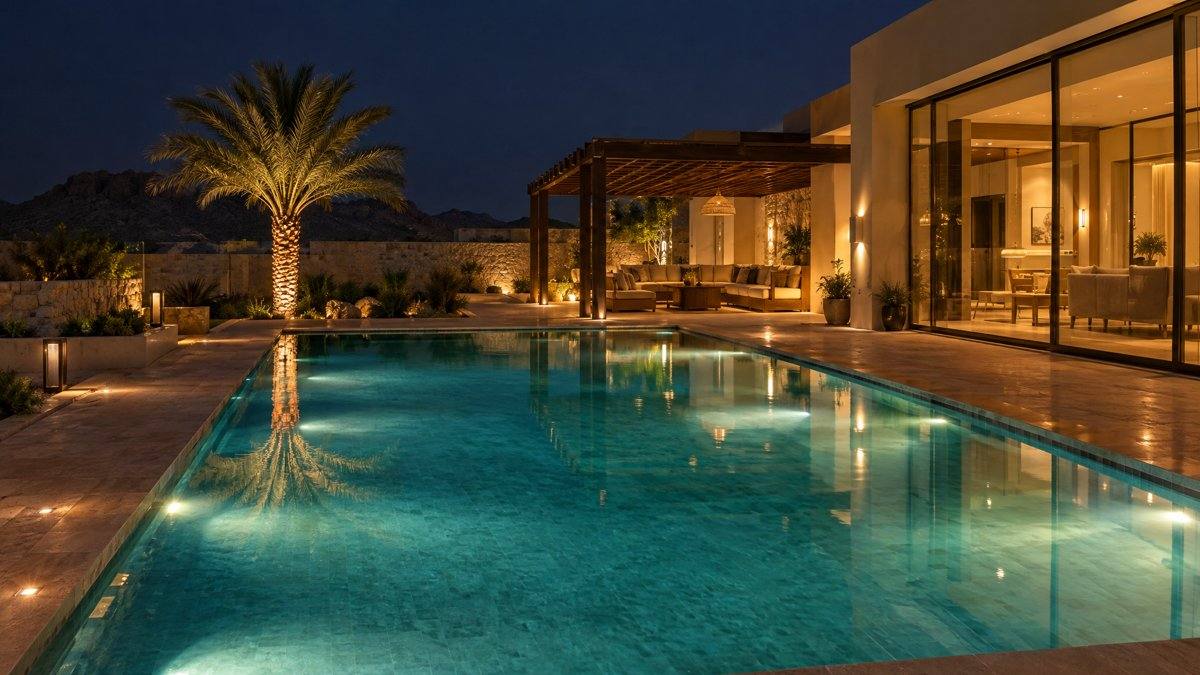
- Submersible fittings rated IP68 and low voltage (12 or 24 V), with the transformer outside the water.
- Install them in the wall opposite the main seating or viewing position, so they don’t dazzle the eye.
- Number and output depend on the pool’s area, depth and tile colour; light tiles reflect more light.
- Indoor pools: avoid ceiling fittings directly above the water; their reflection on the surface is irritating and maintenance is difficult. Use underwater lighting and indirect lighting on the walls.
- Fountains and waterfalls: light from beneath where the water falls makes it sparkle.
Fittings and specifications
| Element | Fitting | Protection | Colour |
|---|---|---|---|
| Trees | Spike or recessed in-ground spotlight with a beam angle suited to the size | IP65 – IP67 | 2700K – 3000K |
| Palms | Narrow spotlight for the trunk and wider for the fronds | IP65 – IP67 | 3000K |
| Pathways | Bollard, low wall fitting, edge strip | IP65 | 2700K – 3000K |
| Exterior walls | Washer or grazer | IP65 | Depending on the material |
| Pool | Low-voltage submersible fitting | IP68 | White or colours as preferred |
Light, shadow and the environment
A beautiful garden at night has areas that are dark on purpose. Lighting every tree and every corner robs the scene of depth and adds to light pollution, which disturbs birds and insects and hides the sky. Choose what deserves highlighting, reduce light aimed upwards without purpose, and use a timer that switches off decorative lighting late at night.
Pre-installation checklist
- A garden plan showing current and future tree positions, seating areas and pathways.
- Underground cable conduits with spare capacity for expansion, laid before planting and paving.
- Waterproof junction boxes above irrigation level.
- Decorative circuits separated from movement and safety circuits.
- Low-voltage transformers in a dry, ventilated, accessible location.
How to build the layers
- Light trees from the bottom up; for palms, use a narrow beam on the trunk and a wider one on the fronds.
- Spike lights that can be moved as the plants grow.
- Low pathway lighting that doesn’t dazzle, with carefully planned spacing.
- Pools and fountains with fittings designed for continuous submersion and low voltage.
- Reduce light aimed at the sky; the Sultanate of Oman launched a national programme to protect the night sky in 2022.
Common mistakes: Garden
Common mistakeAiming light at glass and mirrors
“Got a spotlight hitting the windows at night? You're blinding your guests!”
- The problem
- Aiming lights at reflective surfaces such as glass creates distracting glare that blocks the view outside.
- Technical explanation
- Light should be aimed at walkways and opaque walls. Avoid aiming lights at windows at night entirely, so you can enjoy the view of the garden.
- The result
- A comfortable evening sitting and a clear view of the villa's garden without distraction.
Common mistakeThe Kelvin crisis on facades
“Your villa has a modern white design, and it's lit in 2700K yellow? That's the biggest architectural mistake!”
- The problem
- Choosing a very warm (heritage-style) light colour on a modern, clean facade makes it look old and yellowed.
- Technical explanation
- Modern facades and gardens suit 4000K (natural white) lighting, while classic designs suit 3000K, and heritage designs 2700K.
- The result
- Bringing out the villa's architectural identity and making it look its finest and most elegant to anyone viewing it from outside.
Common mistakeRandomly placed bollard lights
“Has your garden turned into an airport runway because of your path lights?”
- The problem
- Placing bollard lights too close together, randomly and excessively
- Technical explanation
- The ideal path bollard is spaced every 4 to 5 metres, and its height should ideally be half the width of the area being lit
- The result
- Elegant, calm garden paths with no extra fixture costs
Common mistakeLighting trees the wrong way
“Garden looks gloomy at night? The secret isn’t the trees, it’s the direction of the light!”
- The problem
- Using bright floodlights that hit the trees from above
- Technical explanation
- High-end tree lighting (as in luxury Dubai projects) relies on concealed lighting from below (Up-lighting) to cast dramatic shadows on the walls
- The result
- A home garden that looks like a luxury resort
Common mistakeLighting glass windows
“Have lights aimed at your living room windows? You've just blinded your guests!”
- The problem
- Aiming light at glass makes it act like a mirror, reflecting harsh light into the eyes and blocking the view of the garden.
- Technical explanation
- Light should be directed at walkways and solid walls (Wall Washer), completely avoiding reflective surfaces.
- The result
- A comfortable living room at night with a clear view of the garden.
Installation errorAiming lighting at glass
Aiming ceiling spots at the large living-room windows at night blocks the view of the garden and creates distracting glare.
Installation errorAiming spots at window glass
It blocks the view of the garden at night and creates strong, distracting reflections in the eye.
Installation errorLighting trees from above (Downlighting)
It erases the tree's details. The right approach is to light it from below (Uplighting) to create dramatic shadows.
Installation errorLighting glass at night
Aiming ceiling spots at the large living-room windows at night blocks the view of the garden and creates distracting glare.
Installation errorUsing 5 W spots for tall façades
Trying to highlight a two-storey building with a very weak fixture meant for garden paths.
Frequently asked questions
QuestionCan an in-ground spotlight withstand being walked on and irrigation?
Only if it is rated IP67 and its glass is designed for floors. Most important is drainage around it; otherwise water will pool on top of it.
QuestionHow many bollards do I need for a 20 m pathway?
At a spacing of roughly 4 – 5 m, about four to five posts; the exact number depends on the fitting’s light distribution and the width of the pathway.
QuestionShould I use colours in the pool?
RGB fittings give you the option of colours for occasions, but white remains the most beautiful for everyday use. If you choose a colour fitting, pick one that supports pure white.
Comparisons and facts
ComparisonIP65 vs IP67 lights
“Not every outdoor light can go into your garden floor!”
- The problem
- In-ground lights failing because of pooled rain or irrigation water.
- Technical explanation
- IP65 protects against water jets and is excellent for facades. But lights set into the ground need IP67 (protection against temporary immersion in water) to withstand irrigation water and rain.
- The result
- Fittings that last for years in the garden soil without burning out.
ComparisonFixed in-ground light vs. Spike light
“Your garden plants grow... but their lighting never changes?”
- The problem
- Fixed in-ground lighting can’t keep up with trees as they grow and change shape
- Technical explanation
- A Spike light is pushed into the soil, so you can move it, change its angle and set it further back as the tree grows, ensuring perfect coverage at all times
- The result
- A flexible, ever-renewing garden at minimal cost
Spec explainedLighting plants (Spike & Up-light)
“You spent a fortune landscaping your garden... and at night it looks like a graveyard?”
- The problem
- Failing to bring out the beautiful texture of tree trunks and leaves
- Technical explanation
- Using a 3000K Spike light with a narrow angle (Up-light) that shines from the trunk upward brings out the tree’s colour and creates wonderful dramatic shadows on the villa walls
- The result
- A garden full of life that invites you to sit outside at night
ComparisonLighting plants: warm vs. coloured green
“Have trees in your garden? Don’t buy a green light to light them!”
- The problem
- Using green light on plants makes them look artificial and eerie
- Technical explanation
- Luxury lies in lighting trees with warm yellow (3000K) or natural (4000K) light to bring out their true natural colour
- The result
- A natural garden overflowing with life and calm
Spec explainedGarden protection (IP67)
“You wash down your courtyard and the in-ground light shorts out? That's a deadly mistake!”
- Technical explanation
- Recessed in-ground lights need IP67 protection because they are temporarily submerged in water during rain or washing.
- The result
- Total safety for children and a long life for your courtyard fittings.
FactGarden lighting is an illusion
There's no need to flood your garden with powerful floodlights; small, well-planned lights aimed at tree trunks give you a “luxury resort” feel from inside your living room.
FactGlass reflects your image, not light
Aiming light at glass windows at night turns them into mirrors that reflect the light into your eyes and stop you seeing the garden outside.
FactBollard lights shouldn't be placed randomly
Their ideal height is half the width of the path being lit, with 4-5 metres between them.
FactIP67 is not suitable inside swimming pools
IP67 garden lights withstand temporary submersion (rain and washing), but inside the pool you must use IP68 only.
FactIP67 is not for pools
This rating withstands temporary immersion (for garden floors), while inside a pool you must use IP68 only.
References
- DarkSky and IES: Five principles for responsible outdoor lighting
- ILP Lighting Journal: Lighting pools and wet areas
- Hydrel: Swimming pool lighting guide
- Counsilman-Hunsaker: Underwater pool lighting (MAHC)
The content is adapted and developed from these references for Gulf homes, not a literal translation.