
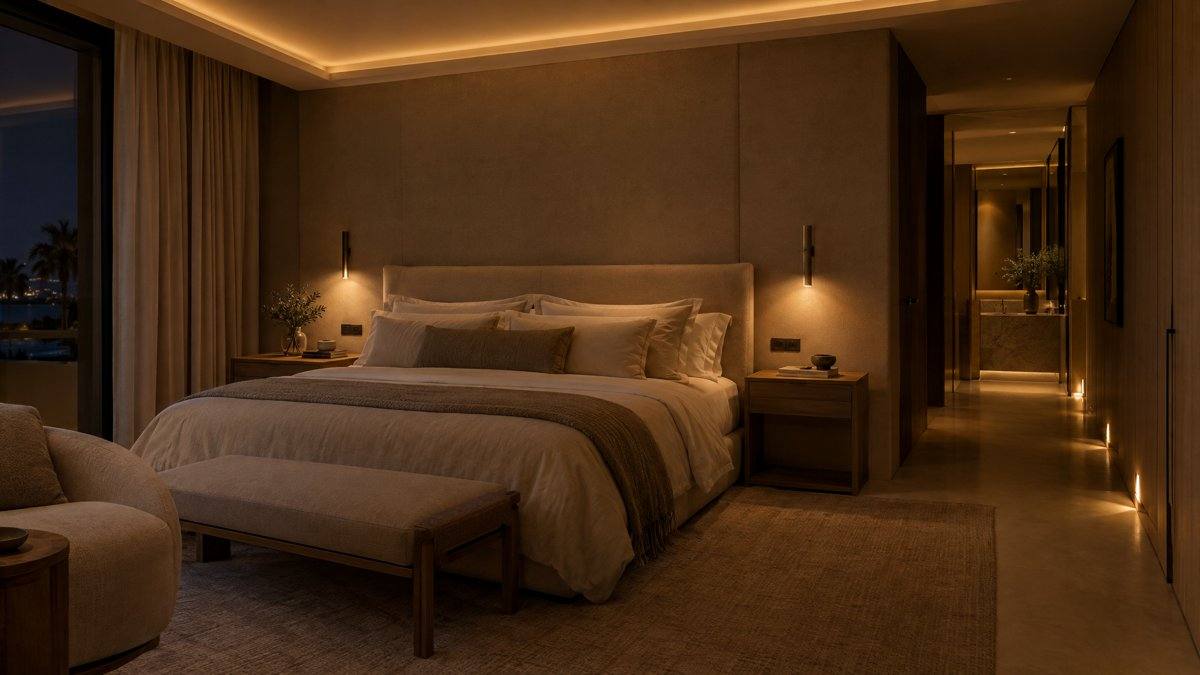
Bedroom lighting: The complete guide
A bedroom is often seen while lying down, which is why a spotlight directly above the bed is one of the most irritating mistakes. What you want is warm, low light from several sources that can be dimmed.
Recommended values
Guide values; the final design depends on the space, its colours and its use.
The most common mistake: a spotlight above the bed
Most gypsum ceiling plans place spotlights in an even grid that includes the area above the bed. The result is that whoever lies down looks straight into the fixture, and ends up switching all the lights off and relying on a phone or a bedside lamp. On top of that, light falling down onto the pillow does not help with reading, because it comes from behind the book.
The rule: the area above the bed stays calm. General lighting moves to the edges of the room and in front of the wardrobes, and reading light comes from the side.
The layers of a bedroom
| Layer | Example | Purpose |
|---|---|---|
| Ambient lighting | A concealed cove in the gypsum ceiling, or a wash on the wall behind the bed | Soft light that fills the room without a visible source |
| Reading lighting | A bedside lamp, a side pendant or an adjustable wall light | Reading without disturbing your partner |
| General lighting | A few spotlights at the edges and in front of the wardrobes | Cleaning and getting dressed |
| Wardrobe lighting | Inside wardrobes and the dressing room | Seeing colours |
| Night lighting | A low wall light near the floor, or a strip under the bed | Moving around at night without waking anyone |
Reading without disturbing
- The reading light sits beside the bed at roughly shoulder height, aimed at the page, not the face.
- A side pendant or a wall light with an arm frees up the bedside table, and ideally has its own switch within easy reach.
- A narrow, focused beam lets one person read while the other sleeps.
- Reading light should be warm in colour, and can be slightly brighter than the rest of the room.
Light and sleep
Published studies indicate that bright, cool white light in the evening delays the release of melatonin and affects sleep, while dim warm light has less impact. That is why 2700K – 3000K is preferred in bedrooms, with the ability to dim to very low levels in the evening.
- Every layer in the room should be dimmable, especially the concealed lighting.
- Avoid blue or bright RGB lighting in bedrooms.
- Night lighting along the path to the bathroom should be dim and close to the floor, and can be linked to a motion sensor.
Wardrobes and the dressing room
- Inside wardrobes: a vertical line of light on both sides of the door, or a horizontal one under the shelf, with a sensor that switches on when the door opens.
- The dressing room needs CRI 90 or higher and enough light to see true colours, at 3000K – 4000K.
- A full-length mirror should be lit from both sides or from the front, not from above the head.
Control from the bed
One of the most irritating things in a bedroom is having to get out of bed to switch off the light. Plan switches on both sides of the bed to control the main lighting and the reading lights, and a switch at the door that turns on the ambient lighting. A Two-way switch between the door and the bed is one of the simplest details, and one of the most comfortable.
Checklist before the gypsum ceiling
- The final bed position fixed, with no spotlights above it.
- Electrical boxes for reading lights on both sides of the bed at a suitable height.
- Two-way switches between the door and the bed.
- A power feed for wardrobe and dressing room lighting.
- A point for night lighting near the floor along the path to the bathroom.
How to build the layers
- Soft perimeter cove lighting as the base layer.
- Bedside lamps or pendants for reading, on a separate circuit.
- Avoid spotlights above the head of the bed; move them to the edges of the room or towards the wardrobes.
- High-CRI lighting inside wardrobes and the dressing room.
- Low night lighting near the floor along the path to the bathroom.
Common mistakes: Bedroom
Common mistakeFacade lighting and windows
“You installed powerful floodlights on your villa facade, but the light hits the windows and keeps you up at night?”
- The problem
- Aiming facade lights at a wide, random angle lets light spill into the bedrooms.
- Technical explanation
- Exterior lighting needs a very narrow beam and precise aiming (Narrow beam) so it lights only the architectural details without causing disturbance.
- The result
- An eye-catching, elegant facade, with complete calm and comfortable darkness inside the bedrooms.
Common mistakeThe hidden 220V hazard
“Planning cove lighting somewhere within reach of your hand? Never buy 220V!”
- The problem
- Using cheap 220V (High voltage) strip in TV shelving or bedrooms where it can be touched.
- Technical explanation
- 220V strips are meant for high ceilings, with runs of up to 50 m, but they are not shock-safe. For shelving, use 24V, which is completely safe.
- The result
- Complete protection for children and your family against any electrical short circuit.
Common mistakeBedroom lit by a single source
“Relying only on ceiling Spots in your bedroom? That’s like cooking with one spoon!”
- The problem
- Using only ceiling lighting makes the room flat and uncomfortable when lying down
- Technical explanation
- Bedrooms need Layered lighting: concealed perimeter lighting, a reading lamp, and low-level accent lighting
- The result
- A hotel feel, peace of mind and deeper sleep
Common mistakeLighting around the TV screen
“Watching a movie in the dark and getting a headache? Turning on the ceiling light isn’t the fix!”
- The problem
- The sharp contrast between a dark room and a bright screen strains the eyes
- Technical explanation
- A soft light strip behind the TV (Bias lighting) reduces eye strain and gives the screen a sense of depth and luxury
- The result
- A home cinema that is very comfortable for your eyes and your children’s
Common mistakeChoosing watts and ignoring lux
“Asking the electrician to fit a 20W light in your office? You’re speaking the wrong language!”
- The problem
- Watts define electricity consumption, while offices need the intensity of light falling on the surface (lux) to be measured
- Technical explanation
- An office needs 500 lux on the desk surface, while corridors need only 100 lux
- The result
- Healthy lighting for your eyes: not so strong it blinds you, not so weak it puts you to sleep
Common mistakeLighting the TV area
“Have ceiling lights between you and the TV? That’s the biggest mistake for eye strain.”
- The problem
- Sharp contrast and glare reflected from the screen
- Technical explanation
- The TV area needs backlighting behind the screen (Bias Lighting), with the ceiling fixtures between the viewer and the screen switched off completely to ease strain on the pupils
- The result
- A home cinema experience that protects your children’s eyes
Installation errorChoosing a high Kelvin for bedrooms
Using lighting of 4000K and above in bedrooms reduces melatonin production and causes insomnia.
Frequently asked questions
QuestionShould I put spotlights in the bedroom?
Yes, a few, at the edges and in front of the wardrobes, but never above the bed.
QuestionWhat is the best colour temperature for a bedroom?
2700K – 3000K, with dimming on every layer. Cool white suits the dressing room more than the bedroom.
QuestionHow can I read without disturbing the person sleeping next to me?
With a narrow side reading light aimed at the page, on its own switch within easy reach.
Customer questionIs it okay to install 4000K lighting in bedrooms?
The answer: Not recommended, as it causes insomnia; 3000K is preferred.
Customer questionIf I'm buying hidden LED strip for my bookshelf, which is within children's reach, what voltage is safe?
Comparisons and facts
Spec explainedGarden protection (IP67)
“You wash down your courtyard and the in-ground light shorts out? That's a deadly mistake!”
- Technical explanation
- Recessed in-ground lights need IP67 protection because they are temporarily submerged in water during rain or washing.
- The result
- Total safety for children and a long life for your courtyard fittings.
Comparison3000K vs. 4000K
“Can't decide between warm yellow or natural white for your project?”
- The problem
- Choosing a gloomy colour for the façade or a harsh colour for bedrooms.
- Technical explanation
- 3000K warm yellow is ideal for classic styles and relaxation. 4000K bright white is ideal for clean modern façades and kitchens.
- The result
- Smart consistency that shows off your home's beauty correctly.
Comparison220V strip vs 24V strip
“Buying an LED strip for cove lighting without knowing the difference in voltage? Careful, this mistake could be dangerous!”
- The problem
- Choosing a 220V strip for close or touchable locations because it is cheap and easy to install.
- Technical explanation
- 220V is excellent for long runs but is not safe to touch directly. 24V is very safe and ideal for short runs, but needs a separate driver.
- The result
- Protecting the family and children from electric shock, and longer-lasting lighting.
ComparisonCeiling lighting (downlights) vs Wall Sconces
“Setting up your bedroom? Never rely on ceiling lights alone!”
- The problem
- Direct ceiling light is very uncomfortable when lying in bed.
- Technical explanation
- Bedrooms need comfortable indirect lighting. Wall Sconces or bedside lamps eliminate glare and provide warm light for reading and relaxing.
- The result
- Better sleep and mood, and a calm “mood” before bedtime.
Spec explainedHidden flicker (Flicker-Free)
“Filming a Snap or a video at home and seeing lines moving on the screen? That lamp is silently damaging your eyes!”
- The problem
- Cheap lighting has fluctuations invisible to the naked eye that tire the brain and cause headaches.
- Technical explanation
- High-quality drivers provide a constant current that produces completely Flicker-Free light.
- The result
- Healthy eyes for you and your children during study time, and crystal-clear videos at family occasions.
ComparisonStaircase lighting: low-level wall lights vs ceiling spots
“The most dangerous place in your home is the staircase! Here's how to light it properly.”
- The problem
- Lighting the stairs from the ceiling casts the person's shadow onto the steps, which causes tripping.
- Technical explanation
- The best solution is low-level recessed wall lights (Wall recessed) at a height of 30 cm that light the treads directly, with no shadows.
- The result
- Complete safety for you and the children, and an elegant architectural look.
Spec explainedDimmable fixtures
“Why live with the same lighting mood morning and night?”
- The problem
- Fixed lighting that doesn’t adapt to the time of day or your mood
- Technical explanation
- Fixtures and Drivers that support Dimming let you lower the light level to create a comfortable space for watching TV or relaxing before bed
- The result
- Control your mood and wellbeing at the touch of a button
ComparisonDimmable vs. standard Drivers
“Why live with the same light level 24 hours a day?”
- The problem
- Not being able to adjust the room’s night-time mood
- Technical explanation
- Dimming isn’t a luxury: it reduces electricity consumption and prepares the brain for deep sleep by lowering the brightness of the LED
- The result
- Real relaxation at home after a long day at work
Spec explainedGeometric spacing (Spacing d=h)
“How far apart should the lights in your corridor be? Two metres is wrong!”
- Technical explanation
- The correct distance between any two fittings (d) should equal the height of the ceiling above the floor (h).
- The result
- A fully and evenly lit corridor with no “dark patches” that frighten the kids.
Spec explainedIndirect Lighting
“How do you light your bedroom without a single light shining in your eyes?”
- Technical explanation
- Indirect lighting (concealed or bounced off the ceiling) creates a glare-free ambient atmosphere, ideal for relaxing and unwinding.
- The result
- Exceptional comfort and deeper sleep for you and your family.
References
- Lighting Research Center: Lighting Patterns for Homes
- Published studies on the effect of evening light on melatonin, including Lee et al. (2018)
- CIBSE recommendations for lighting levels in dwellings
- Address Lighting knowledge base
The content is adapted and developed from these references for Gulf homes, not a literal translation.