
Home / By room / Facades & Boundary Walls
Facades & Boundary Walls lighting: The complete guide
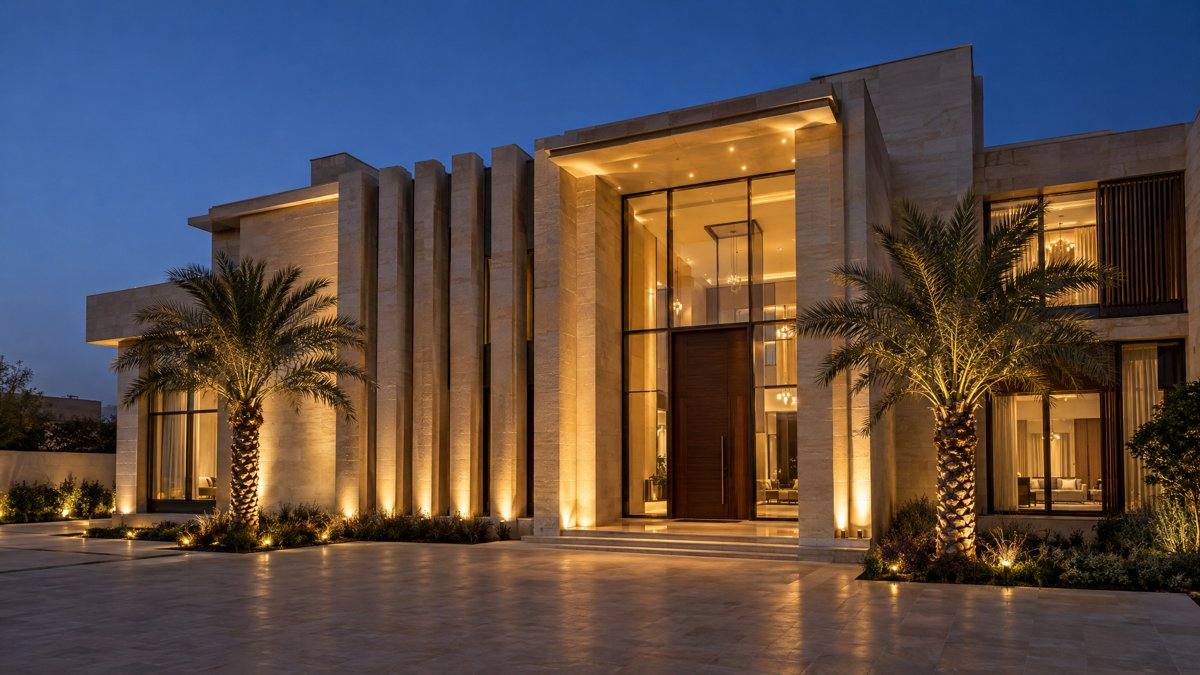
At night, your facade is the first thing people see of your home. The aim is to bring out the architecture, not flood it with light, while respecting the neighbours and the night sky.
Recommended values
Guide values; the final design depends on the space, its colours and its use.
The principle: highlight, don’t flood
Good facade lighting doesn’t fill the building with light. It picks out the elements that tell the story of the architecture, such as columns, the entrance, projections, stonework and frames, and leaves calmer areas between them. That contrast between lit and quiet is what gives a facade depth and elegance at night.
The practical rule: if you switch off half the facade fittings and lose nothing of its beauty, that half was never needed in the first place.
Before any fitting: read the facade
- Identify the masses and prominent elements, and what can be seen from the street and from the entrance.
- Identify the material: rough stone loves grazing light, smooth paint loves soft washing, and glass is not lit itself; light what surrounds it.
- Identify the heights: a 6 m column needs a different angle and output from a 3 m column.
- Identify where it will be seen from: a distant viewer sees the overall composition, while someone close up sees the texture and details.
Five ways to light a facade
| Method | What it gives | When it suits |
|---|---|---|
| Ground up-lighting (Up-light) | Emphasises height and columns and creates dramatic shadows | Columns, classical facades, trees close to the building |
| Wall-mounted down-lighting (Down-light) | Soft light that draws a line from above and reduces light directed at the sky | Entrances, solid walls, modern facades |
| Dual lighting (Up & Down) | Two beams from one fitting drawing two opposing lines | Columns and wall sections between windows |
| Grazing | Strongly brings out texture and projections | Natural stone, brick and rough cladding |
| Wall Washing (Washing) | An evenly lit, soft surface | Smooth walls and painted boundary walls |
Columns and frames
A column is lit with a narrow beam that keeps the light on the column alone, from below, from above or from both directions. The taller the column, the narrower the beam angle required and the more powerful the fitting. A ground fitting is set a short distance from the base of the column so the light skims its surface rather than just hitting its base.
Around windows and frames, the light is aimed at the solid mass, not at the glass; lit glass turns into a mirror at night, reflecting light back indoors and disturbing the occupants.
Boundary walls and gates
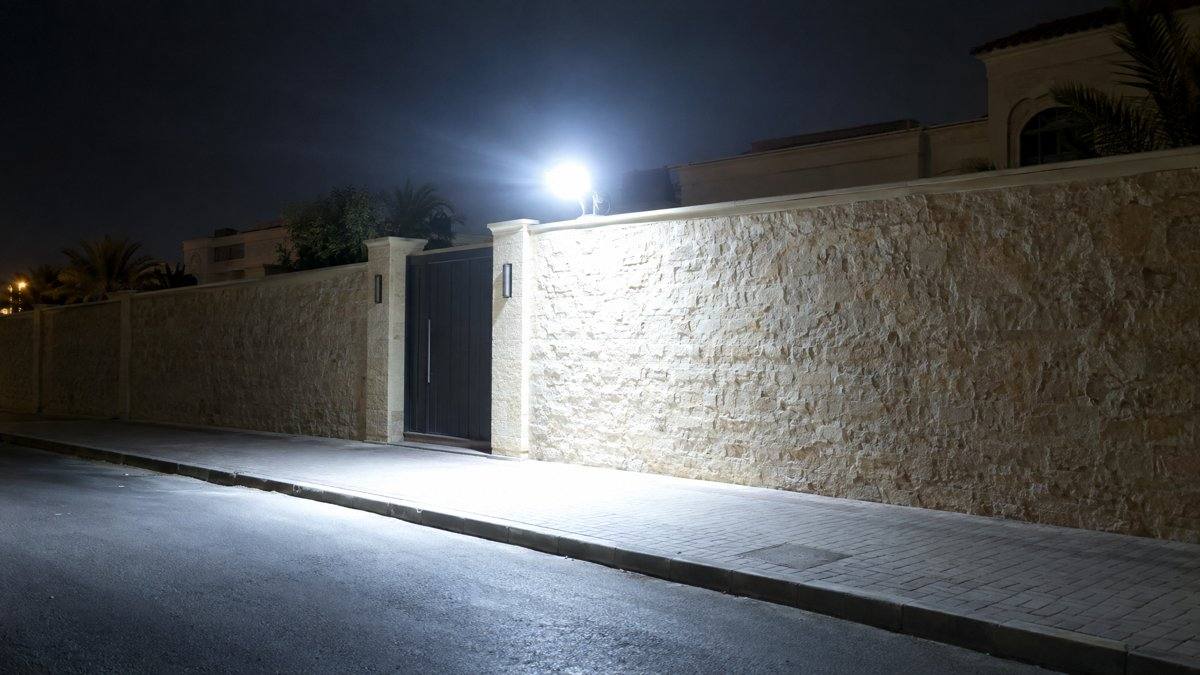
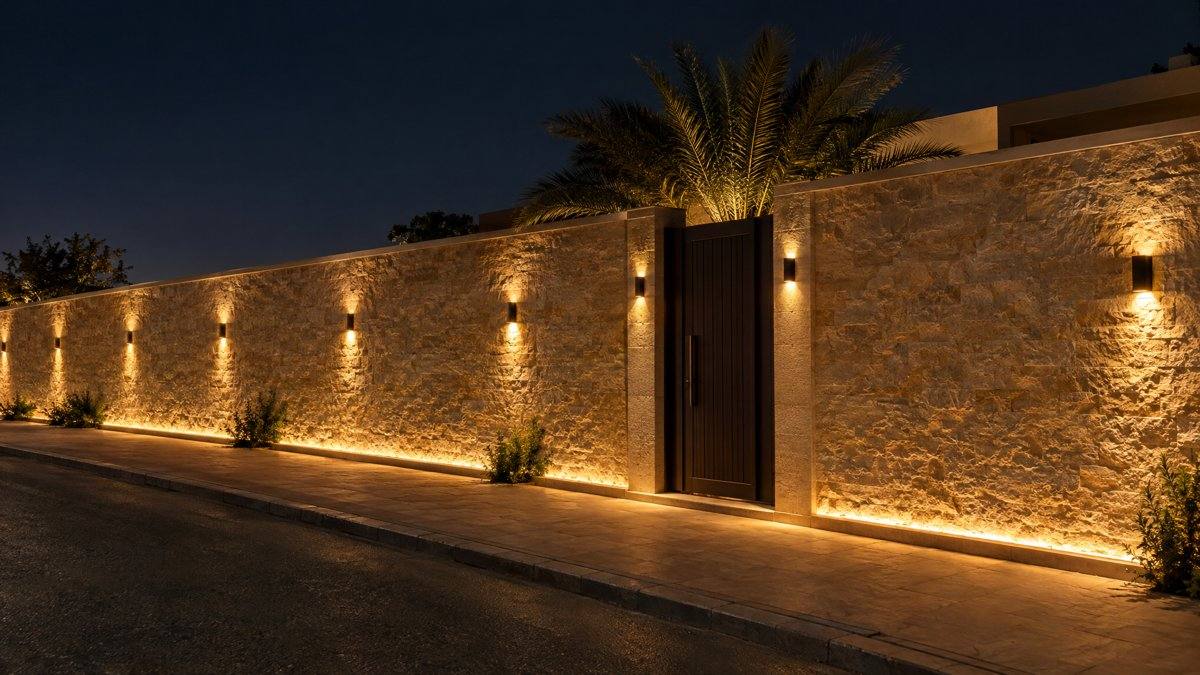
A boundary wall is lit in one of three ways: from the tops of the pillars with down-lights, from the ground with up-lights, or from within recesses in the wall. The choice depends on the dimensions of the mass, how often it repeats and the budget. A long wall doesn’t need a fitting at every pillar; you can alternate, or highlight only the gate and the corners.
Split the boundary wall and facade into separate circuits so you can switch on only what you need: full lighting for occasions, reduced lighting for every night, and switching off what isn’t needed in the late hours.
Fittings and specifications
- Colour temperature: 2700K – 3000K for stone and warm colours. 4000K for some white or grey modern facades, and never mix the two on one facade.
- Colour rendering: CRI 80 as a minimum, and 90 for natural stone so its true colour shows.
- Protection: IP65 for wall-mounted fittings, IP67 for in-ground fittings that may be submerged by irrigation water or rain.
- Material: well-coated aluminium or stainless steel suited to the coastal environment, with genuine outdoor gaskets and cables; water usually gets in through the joint, not the body.
- In-ground fittings: heat-resistant, walk-over glass, and a ring that prevents glare in passers-by’s eyes.
- Avoid visible linear strips on the facade as far as possible; they read as a bright line of light instead of revealing the beauty of the facade.
Lessons from the German school (ERCO)
- Floodlighting spreads light evenly across the facade, so it looks flat, like a single mass. Use it to show the building as a whole, not as the only approach.
- Grazing light brings out details with strong shadows and works well on surfaces up to a height of about 6 m. A grazing ground fitting sits about 30 cm from the wall.
- Indoor lighting levels are far too high for outdoors; at night, less than 100 lux on light-coloured surfaces is usually enough.
- Don’t light clear glass: the light reflects and passes through it instead of revealing it.
- Stop light from spilling beyond the plane of the facade; anything that goes past it is light pollution.
Respecting the neighbours and the sky
Light that escapes the intended element is wasted: it enters the neighbours’ rooms, dazzles drivers and lights up the sky. Use narrow beam angles and shielding rings, aim the light at the building rather than into open space, and prefer down-lighting where it does the job. In 2022 the Sultanate of Oman launched its National Night Sky Protection programme, and a well-considered facade is part of that awareness.
- The five principles for responsible outdoor lighting, issued by DarkSky with the Illuminating Engineering Society (IES): useful (every light has a clear purpose), targeted (it falls only where needed), low level (no brighter than necessary), controlled (timers, sensors and dimming), and as warm in colour as possible.
Pre-installation checklist
- A facade drawing showing the elements chosen for lighting and how each one is lit.
- Ground and wall power points prepared before tiling and cladding.
- Suitable outdoor conduits and cables, and waterproof junction boxes.
- Separate circuits: facade, boundary wall, garden, pathways.
- A timer or photocell for automatic switching.
How to build the layers
- Decide which elements deserve highlighting: columns, the entrance, projections, stonework. Don’t light everything.
- Facade columns: a narrow floodlight from below or above that keeps the light on the column.
- Natural stone: close-in Grazing light to bring out the texture.
- Boundary wall pillars: fittings scaled to the size of the mass, with circuits split for control.
- Aim light away from windows, neighbouring homes and the sky, and switch off what isn’t needed late at night.
Common mistakes: Facade
Common mistakeFacade lighting and windows
“You installed powerful floodlights on your villa facade, but the light hits the windows and keeps you up at night?”
- The problem
- Aiming facade lights at a wide, random angle lets light spill into the bedrooms.
- Technical explanation
- Exterior lighting needs a very narrow beam and precise aiming (Narrow beam) so it lights only the architectural details without causing disturbance.
- The result
- An eye-catching, elegant facade, with complete calm and comfortable darkness inside the bedrooms.
Common mistakeThe facade-lighting mistake of mounting flush to the wall
“Want your facade light to throw a stunning beam? Don't mount it flush against the wall!”
- The problem
- Mounting wall lights flush against the wall creates a harsh, very distracting Hotspot that spoils the facade.
- Technical explanation
- Moving the fitting slightly away from the wall and choosing the correct aiming angle gives a long, ideal beam that highlights the villa's height up to 16 m.
- The result
- A facade that catches the eye of the whole neighbourhood, at low cost and with smart installation.
Common mistakeOverdoing outdoor lighting (Floodlights)
“Installed stadium floodlights on your villa facade? You haven't lit it up, you've washed out its features!”
- The problem
- Flooding the facade with wide light erases the architectural details and creates light pollution.
- Technical explanation
- Highlighting a facade needs a well-planned layout of upward and downward Spotlights with narrow beams to create “contrast” between light and shadow, because shadow is what reveals the beauty.
- The result
- A palace-like facade with a far smaller electricity and installation budget.
Common mistakeFalse savings on the lighting budget
“Want to save on your lighting budget? Don't buy cheap, use the “hybrid system”!”
- The problem
- Buying cheap products for the whole villa to save money, which leads to burnt-out fittings and double the maintenance cost.
- Technical explanation
- The hybrid system means combining very high-spec fittings (for the majlis, living rooms and facade) with mid-range fittings (for service rooms and storerooms).
- The result
- Cutting costs by up to 40% while keeping 100% of the luxury in the areas guests see.
Common mistakeThe Kelvin crisis on facades
“Your villa has a modern white design, and it's lit in 2700K yellow? That's the biggest architectural mistake!”
- The problem
- Choosing a very warm (heritage-style) light colour on a modern, clean facade makes it look old and yellowed.
- Technical explanation
- Modern facades and gardens suit 4000K (natural white) lighting, while classic designs suit 3000K, and heritage designs 2700K.
- The result
- Bringing out the villa's architectural identity and making it look its finest and most elegant to anyone viewing it from outside.
Common mistakeLight pollution and disturbing the neighbours
“Installed lights on your home's facade, but the light reaches your neighbour's bedroom?”
- The problem
- Aiming outdoor lights at wide, random angles causes light pollution and disturbs the surroundings.
- Technical explanation
- Using outdoor lights with a narrow beam (Narrow Beam <15°) keeps the light on the facade column only, without spilling into windows.
- The result
- An elegant, well-defined facade, and complete comfort for your family and neighbours.
Common mistakeGround Up-light right against the wall
“Installed a ground light on your façade and now it shows every flaw in the plaster and paint?”
- The problem
- Installing the ground light tight against the wall creates ugly shadows from every small bump (Grazer effect)
- Technical explanation
- Unless the wall is stone or has an intentional texture, the light must be set back (Offset) to wash the wall softly without exposing its flaws
- The result
- A smooth, luxurious façade that hides the contractor’s mistakes
Common mistakeModern façades and yellow light (2700K)
“A modern villa with a clean design, lit with traditional yellow? Biggest mistake!”
- The problem
- Choosing a very warm Kelvin for modern façades makes them look gloomy and yellow.
- Technical explanation
- Modern façades suit 4000K (natural white) for its clean look, while 3000K suits classic and 2700K suits traditional styles.
- The result
- Presents the villa's architectural identity in its truest form.
Common mistakeChoosing the wrong wattage for façades
“Want your villa façade to stand out from afar? Don't fit it with a 5 W light!”
- The problem
- Using very weak Grazer fittings for tall façades.
- Technical explanation
- A tall façade needs a 36 W fitting (about 2300 lm) to reach the top of the building, while 5 W (300 lm) is left for soft lighting of lower walkways.
- The result
- A palace façade that catches the eye of the whole neighbourhood.
Installation errorBuying IP20 lighting for outdoors
Installing indoor lighting on the villa façade or inside bathrooms causes it to fail quickly and short-circuit.
Installation errorMounting façade wall spots tight to the wall
Placing the outdoor spot right against the wall creates a very ugly patch of light; it should be moved slightly away and its angle adjusted.
Installation errorRandomness on façades
Flooding the villa façade with floodlights instead of aiming two or three narrow-beam Spotlights to highlight the columns.
Installation errorBuying a Grazer without defining the goal
Buying an ordinary Wall Grazer to light a 10 m high façade, when tall façades need a professional narrow-beam Grazer with special lenses.
Installation errorFlooding the villa façade with floodlights
Using very powerful floodlights that erase the villa's architectural features, instead of small aimed spots that highlight the columns and the shadows.
Frequently asked questions
QuestionHow many fittings do I need for a villa facade?
There’s no fixed number. The count is set after choosing the elements that deserve highlighting; many beautiful facades are lit with a small number of cleverly placed fittings, more so than facades crowded with fittings.
QuestionYellow or white for the facade?
Warm (2700K – 3000K) suits stone, earthy colours, and classical and Omani styles. Neutral (4000K) may suit a white or grey modern facade. What matters is not mixing them.
QuestionShould I light the balcony ceilings with spotlights?
Only where you need functional light for sitting or moving around. Repeating spotlights in every outdoor ceiling fills the facade with bright dots without highlighting the architecture.
Customer questionWhich is better for the façade: a ground spot shining upward (Up-light) or a spot from above shining down?
The answer: There's no single answer: up-lighting highlights columns and height, while down-lighting suits projections and entrances and reduces light going into the sky. Most beautiful façades combine both, depending on their details.
Customer questionWhich is better for the façade: the ground spot that shines upward or the spot from above?
The answer: It depends on the architecture: up-lights for columns and height, down-lights for projections and entrances. Combining both with narrow beams gives the most beautiful result and the least light pollution.
Customer questionShould I install a ground spot shining up or a ceiling spot shining down on the façade?
The answer: Combining them is best, depending on the architectural projections.
Customer questionI have natural stone on my façade. How do I bring it out?
The answer: With a Wall Grazer placed very close to the stone.
Customer questionWhy does the ground façade spot show every flaw and wave in the wall?
The answer: Because you placed it tight to the wall in Grazer mode; it should be moved slightly away.
Customer questionI have a tall column on the façade. How do I light it all the way up without blinding the neighbours?
The answer: A ground spot with a very narrow beam of 5–10°.
Comparisons and facts
ComparisonWall Washer vs Wall Grazer
“Want to light a stone or marble wall? Mix up these two fittings and you'll regret it!”
- The problem
- Not knowing which type of light suits the nature of the wall.
- Technical explanation
- A Wall Washer spreads light softly and hides wall imperfections (excellent for plain walls). A Wall Grazer casts light at a sharp angle to bring out patterns and texture (excellent for stone and marble).
- The result
- Showcasing the beauty of expensive materials (such as stone and marble) that you have invested heavily in.
Spec explainedDMX system for facade lighting
“Want your villa facade to celebrate National Day or Ramadan? This technology isn't just for hotels!”
- The problem
- The home's facade is static and dull and can't be refreshed for special occasions.
- Technical explanation
- A DMX control system lets you change the colours of the exterior lighting, programme it, and create smart rhythmic sequences.
- The result
- A villa that stands out from all your neighbours and celebrates your occasions at the tap of a phone app.
ComparisonWall Washer vs. Wall Grazer
“Installed expensive natural stone on your façade? Don’t ruin it with the wrong fixture!”
- The problem
- Confusing the two fixtures destroys the luxury of the wall
- Technical explanation
- A Wall Washer smooths the wall and hides imperfections. A Wall Grazer is installed very close to the wall to bring out the relief and texture of natural stone and marble
- The result
- Showing off the fortune you spent on the stone façade at its very best
ComparisonConventional approach vs. the “hybrid approach”
“Want to save 40% of your lighting budget without losing the luxury? The secret is hybrid!”
- The problem
- Buying expensive products for the whole villa, or cheap ones for the whole villa
- Technical explanation
- The hybrid approach means using very high-spec fixtures (for the Majlis, living rooms and façade) and mid-quality fixtures (for service rooms and storerooms)
- The result
- Smart budget savings while still impressing guests in the reception areas
Spec explainedDMX system for façades
“Your façade is static and boring? Imagine it responding to National Day or special occasions!”
- The problem
- Façades are rigid and their character can’t be refreshed
- Technical explanation
- DMX control systems program outdoor RGB floodlights to change their colours and rhythm according to smart programming you control from your panel
- The result
- A distinctive villa that reflects your celebrations and happy occasions in the finest way
Comparison5° ground Up-light
“Lit up your façade and all the light shot off into the sky?”
- The problem
- Using wide ground lights for tall columns
- Technical explanation
- Tall, slim columns need a very narrow Beam Angle (5°–10°), almost like a laser, to focus on the architecture without polluting the sky
- The result
- Clearly showcasing the height and grandeur of the villa
Spec explainedCooling outdoor lighting
“Will your façade lights survive the summer? If the heatsink is weak, they'll melt!”
- Technical explanation
- Outdoor fittings need solid, large aluminium heatsinks to dissipate LED heat in Gulf conditions that reach 50 degrees.
- The result
- A lit façade all year round with no sudden burnouts.
Comparison3000K vs. 4000K
“Can't decide between warm yellow or natural white for your project?”
- The problem
- Choosing a gloomy colour for the façade or a harsh colour for bedrooms.
- Technical explanation
- 3000K warm yellow is ideal for classic styles and relaxation. 4000K bright white is ideal for clean modern façades and kitchens.
- The result
- Smart consistency that shows off your home's beauty correctly.
FactAiming light at mirrors is a disaster
Placing a spotlight facing a bathroom or entrance mirror makes it reflect the light straight into your eyes like a floodlight.
FactDMX isn't just for parties
You can use DMX systems with very simple programming to light the villa façade and change it according to the season or your mood.
References
- ERCO: Facade lighting
- ERCO: Planning light for monumental buildings
- DarkSky and IES: Five principles for responsible outdoor lighting
- Oman Observer: The National Night Sky Protection programme
The content is adapted and developed from these references for Gulf homes, not a literal translation.