
Home / By room / Majlis & Living Room
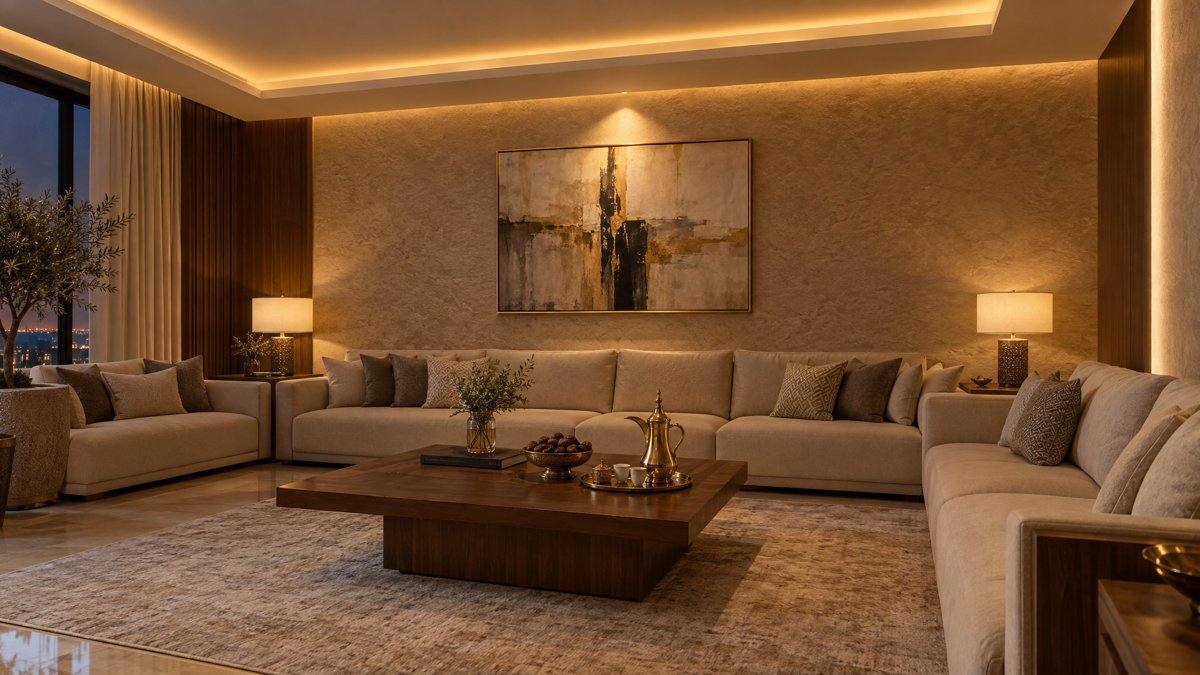
Majlis & Living Room lighting: The complete guide
The space guests see most, and the one where the Swiss-cheese ceiling of too many downlights is most often seen. A majlis needs layers: dimmable general lighting, accent lighting on walls and features, and decorative lighting that gives it character.
Recommended values
Guide values; the final design depends on the space, its colours and its use.
The most common mistake: a chandelier alone, or a perforated ceiling
Most majlis designs fall into one of two traps: relying on a grand chandelier as if it were enough to light the whole space, or filling the ceiling with rows of identical spotlights. A chandelier is a decorative piece designed for mood, and many of them trap much of their light inside the crystal and shades, leaving the edges and walls in darkness. A perforated ceiling, on the other hand, lights the floor and carpets evenly while leaving walls and faces undefined, so the majlis looks flat and cluttered with points of light.
The answer is not more fixtures, but layers: each layer has its own role and its own circuit, and they work together in carefully balanced proportions.
The layers of a majlis
| Layer | Example | Purpose |
|---|---|---|
| Wall lighting | A Wall Washer or concealed lighting on the main wall | Makes the space feel larger and lights faces with soft reflected light |
| General lighting | A few recessed spotlights with a medium beam angle | Movement, cleaning and gatherings |
| Accent lighting | A narrow spotlight on a painting, a stone wall or a display cabinet | A focal point and a sense of identity |
| Decorative lighting | A chandelier, pendants or table lamps | The heart of the seating area, and warmth |
| Concealed lighting | A cove in the gypsum ceiling, a line under the sofa or behind the TV | Calm and depth |
Walls before ceiling
The eye judges how bright a space is from what it sees in front of it, meaning the walls and faces, not from the light falling on the floor. That is why a majlis with lit walls looks larger and brighter than one with stronger light on the floor. Start your layout with the wall facing the entrance and the main wall behind the seating, then add general lighting only as much as is still missing.
A Wall Washer needs a solid wall without windows or too many doors, and is set back from the wall by roughly one third of the ceiling height. If the wall is clad in stone or carved wood, close-range Grazing will reveal its texture far better than a soft wash.
The chandelier in its proper place
- The chandelier defines the centre of the seating area or the table; it should not be relied on to light the whole space.
- Its size should suit the space: as a common rule of thumb, the chandelier's diameter in centimetres is roughly the room's length plus width in metres, multiplied by ten, then adjusted for ceiling height and style.
- In a standard space, its lowest point should be no less than about 2.1 m above the floor in walkways; over a table it can hang lower.
- Put it on its own dimmable circuit, and choose lamps with the same colour temperature as the rest of the majlis.
- A chandelier sparkles most beautifully when its surroundings are calmer; switching off half the spotlights during an evening gathering shows it off more than adding fixtures ever will.
Glare and visual comfort
In a majlis, guests sit for a long time with their heads raised towards whoever is speaking, so they see the ceiling more than you might think. A spotlight with an exposed lens, or one close to the line of sight, creates glare that tires the eyes even when the overall lighting level is right.
- Choose fixtures with a reflector recessed deep in the body or dark inside, or with a Honeycomb louvre.
- Never place a spotlight directly above a seated guest's head; move fixtures to the front of the seating area or to the walls.
- Concealed lighting must be truly concealed: the strip should not be visible from any seat.
Scenes and control
A majlis lives several lives: formal receptions, family evenings, watching TV, cleaning. Divide the circuits by layer, not by location, and make every layer dimmable, including the concealed lighting.
- Reception: walls, accent and chandelier high, general spotlights at medium.
- Evening gathering: walls, concealed lighting and table lamps, with general lighting off or very low.
- Watching TV: soft lighting behind the screen with the concealed lighting, and no light reflecting on the screen.
- Cleaning and large gatherings: everything at full output.
- A scene switch at the entrance replaces a long row of switches.
Checklist before the gypsum ceiling
- A final or preliminary furniture layout; lighting is planned around the seating, not the ceiling grid.
- Positions of paintings, feature walls and display cabinets fixed before ceiling openings are cut.
- The chandelier point and its centre measured from the actual seating area.
- Back boxes for table lamps and wall lights set into the walls before plastering.
- A cove opening deep and high enough to hide the strip and keep it cool.
- Driver locations accessible for maintenance.
How to build the layers
- A Wall Washer or cove lighting on the main wall instead of filling the ceiling with spotlights.
- Accent points on artwork, a stone wall or a decorative piece, around five times brighter than the surroundings.
- A few general spotlights with considered beam angles, on a separate dimmable circuit.
- A chandelier or pendant that defines the centre of the seating area, supported by architectural lighting.
- Bias lighting behind the screen if there is a TV.
- Preset scenes: a formal visit with soft lighting and the decorative pieces lit, and a family gathering with brighter light. Every fitting is dimmable, including the concealed ones.
- A decorative fitting that creates a lighting effect only shows its beauty when the light around it is softer.
Common mistakes: Majlis
Common mistakeFalse savings on the lighting budget
“Want to save on your lighting budget? Don't buy cheap, use the “hybrid system”!”
- The problem
- Buying cheap products for the whole villa to save money, which leads to burnt-out fittings and double the maintenance cost.
- Technical explanation
- The hybrid system means combining very high-spec fittings (for the majlis, living rooms and facade) with mid-range fittings (for service rooms and storerooms).
- The result
- Cutting costs by up to 40% while keeping 100% of the luxury in the areas guests see.
Common mistakeLighting glass windows
“Have lights aimed at your living room windows? You've just blinded your guests!”
- The problem
- Aiming light at glass makes it act like a mirror, reflecting harsh light into the eyes and blocking the view of the garden.
- Technical explanation
- Light should be directed at walkways and solid walls (Wall Washer), completely avoiding reflective surfaces.
- The result
- A comfortable living room at night with a clear view of the garden.
Installation errorAiming lighting at glass
Aiming ceiling spots at the large living-room windows at night blocks the view of the garden and creates distracting glare.
Installation errorLighting glass at night
Aiming ceiling spots at the large living-room windows at night blocks the view of the garden and creates distracting glare.
Common mistakeThe grid-layout trap
“A spotlight every 2 metres? That old rule will cost you on your bill and leave your villa ceiling looking cluttered!”
- The problem
- Filling the ceiling with a huge number of evenly spaced spots (a grid layout), which creates visual noise and strains the eyes.
- Technical explanation
- Smart lighting design places light according to the furniture, artwork and walls, not by random even spacing.
- The result
- Lower installation, electricity and maintenance costs, with a cleaner, more attractive ceiling. (Invite viewers to send their floor plan on WhatsApp for a smart lighting layout.)
Common mistakeThe one-metre, two-metre rule (grid layout)
“A spotlight every 2 metres? That rule will make your villa look like a supermarket!”
- The problem
- Spacing lights evenly (in a grid) wastes electricity and leaves the ceiling full of holes that are tiring to look at.
- Technical explanation
- Real lighting design is based on “task distribution”: lighting only the furniture, corridors and artwork, and leaving restful areas (shadows) to create contrast.
- The result
- A cleaner ceiling with 40% fewer openings, savings on the electricity bill, and twice the sense of luxury.
Common mistakeThe hidden 220V hazard
“Planning cove lighting somewhere within reach of your hand? Never buy 220V!”
- The problem
- Using cheap 220V (High voltage) strip in TV shelving or bedrooms where it can be touched.
- Technical explanation
- 220V strips are meant for high ceilings, with runs of up to 50 m, but they are not shock-safe. For shelving, use 24V, which is completely safe.
- The result
- Complete protection for children and your family against any electrical short circuit.
Common mistakeMounting the track light too close to the wall
“Installed an expensive magnetic track light, but it looks wrong? Because you forgot about the wall!”
- The problem
- Installing the magnetic track too close to the wall prevents light from being directed left and right and spoils the look of the adjustable spots.
- Technical explanation
- The track should be far enough from the wall to allow the Spotlights to be aimed freely at artwork or furniture without hitting the wall.
- The result
- Real flexibility to change the décor later and full use of the magnetic system's advantages.
Common mistakeFixed spotlights above furniture that moves
“Every time you move the sofa, the spotlight ends up shining on empty floor?”
- The problem
- Using fixed recessed fittings in living rooms where the furniture layout changes often.
- Technical explanation
- The solution is to use Zoomable spotlights, which let you widen or narrow the beam angle (from 15° to 36°) by hand without replacing the fitting, or a magnetic track system.
- The result
- Complete freedom for the lady of the house to change the décor and aim the light at new furniture in seconds.
Common mistakeLighting above the dining table
“Put a standard downlight over the dining table? The food will look dull and the shadows will spoil the meal!”
- The problem
- Using general, diffused lighting that doesn't focus on the dishes makes the food and the space less appealing.
- Technical explanation
- The dining table needs focused Accent Lighting with a narrow beam, 5 times stronger than the surrounding general lighting to draw attention.
- The result
- The atmosphere of luxury 5-star restaurants in your home, and a better appetite thanks to accurate colour rendering.
Common mistakeNo directional lighting for artwork
“Bought a painting worth thousands of rials and lit it with a standard downlight? You've practically switched off its beauty!”
- The problem
- Using diffused (Symmetrical) light that doesn't bring out the details of the art.
- Technical explanation
- Artwork needs Asymmetrical lighting or a spotlight aimed at 30° to bring out texture and colour without causing glare on the painting's glass.
- The result
- Turning the villa's walls into an elegant art gallery that catches every visitor's eye.
Common mistakeLighting artwork (Asymmetrical)
“Your expensive painting looks dull with a bright spot glaring in the middle?”
- The problem
- Using a standard (symmetrical) spotlight above paintings creates a harsh hotspot and distracting shadows.
- Technical explanation
- Paintings need asymmetrical fittings (Asymmetrical Wallwasher) that wash the whole painting softly without creating glare on its glass.
- The result
- Turning the villa's walls into a true art gallery.
Common mistakeNeglecting contrast (Contrast)
“Want your majlis to look luxurious? The secret isn't the light... it's the darkness!”
- The problem
- Lighting the whole room at the same intensity makes it look flat and dull.
- Technical explanation
- Luxury (Play of Brilliance) depends on contrast. Casting light 5 times stronger on a table or painting while leaving the corners softer creates stunning visual depth.
- The result
- The atmosphere of palaces and world-class hotels in your majlis.
Common mistakeDining table lighting
“Hosting a lavish dinner, but the food looks dull? Blame your ceiling!”
- The problem
- Using weak general lighting over dining tables
- Technical explanation
- A dining table needs focused “Accent Lighting” at least five times brighter than the surrounding ambient light, to whet the appetite and bring out the details of the table setting
- The result
- An exceptional hosting experience and unforgettable dinner gatherings
Frequently asked questions
QuestionHow many lux does a majlis need?
For everyday seating, 100 – 200 lux is usually enough; for receptions and gatherings it rises to around 300 lux. That is why dimming matters more than a fixed output.
QuestionIs a chandelier enough to light a majlis?
Rarely. A chandelier is decorative and defines the centre of the seating area; it needs support from wall lighting and a few well-planned general spotlights.
Question3000K or 4000K for a majlis?
3000K suits most majlis spaces best: it is warm and comfortable and shows wood and fabric beautifully. 4000K makes a majlis feel cold, like an office.
Customer questionCan I use energy-saving bulbs (CFL) to light paintings and mirrors?
The answer: No, their light is flat and has no sparkle.
Customer questionI have a 7 m high ceiling in the living hall. How do I make sure the light reaches the floor without spots that spoil the ceiling?
The answer: Use fewer fixtures with narrow beams and high lumens, light the tall walls to show off the height, and add wall lights or pendants that bring the light closer to seating level.
Customer questionShould I choose a white or black frame for the living room spots?
The answer: Black, or a dark reflector, reduces visible brightness and keeps the ceiling calm when lit, while white disappears into the ceiling when off. For living rooms and spaces where people sit for long, many designers prefer dark.
Customer questionMy living hall is 6 by 6 m. How many spots do I need?
The answer: It's determined by the layout, not by a random total count.
Customer questionHow do I split the budget between decorative lighting (chandeliers) and architectural lighting (spots)?
The answer: Start with architectural lighting, because it does the functional work, is buried in the ceiling and is hard to change; then choose one or two standout decorative pieces for the most important spaces instead of a chandelier in every room.
Customer questionI have an open staircase in the middle of the living hall. How do I light it without creating shadows?
The answer: Low wall lighting at a height of 30 cm.
Comparisons and facts
ComparisonConventional approach vs. the “hybrid approach”
“Want to save 40% of your lighting budget without losing the luxury? The secret is hybrid!”
- The problem
- Buying expensive products for the whole villa, or cheap ones for the whole villa
- Technical explanation
- The hybrid approach means using very high-spec fixtures (for the Majlis, living rooms and façade) and mid-quality fixtures (for service rooms and storerooms)
- The result
- Smart budget savings while still impressing guests in the reception areas
ComparisonSlim track light vs wide track
“Want lighting that blends into the gypsum as if it isn't there? The secret is the size of the track light!”
- The problem
- Track lighting rails stand out and spoil the décor of majlis rooms and rooms with low ceilings.
- Technical explanation
- Slim fittings (Slim Magnetic Tracks) are visually quieter and blend fully into the gypsum compared with traditional wide systems.
- The result
- A clean, modern ceiling that preserves the room's height.
Spec explainedProtect your family from headaches (UGR)
“Do you sometimes get a headache behind your eyes while sitting in the living room? Your lighting might be the reason!”
- The problem
- Direct glare that causes eye strain.
- Technical explanation
- Professional lighting comes with a glare limit rating (UGR < 19), using deep reflectors or Honeycomb louvres to make sure direct rays don't reach your eyes.
- The result
- Comfort for sitting long hours, reading and watching TV without fatigue.
ComparisonDownlight with Opal lens vs downlight with Reflector
“Two downlights: one gives you a headache, the other helps you relax. What's the difference?”
- The problem
- A white (opal) diffuser spreads light everywhere, and the fitting itself becomes bright and uncomfortable to look at.
- Technical explanation
- Fittings with a deep reflector (Darklight Reflector) direct the light downwards and hide the lamp from view, so the ceiling looks calm and glare-free.
- The result
- Exceptional visual comfort, especially in living rooms where you sit for long periods.
Comparison30° vs 40° Cut-off Angle
“Why do some spots glare at you from across the room, while with others you have to stand right underneath to see them?”
- The problem
- Buying fittings with a shallow reflector that doesn't hide the light source.
- Technical explanation
- The Cut-off angle is what protects your eyes. A deep-set light with a 40° cut-off provides visual comfort (UGR<19) and makes the ceiling look as if it has no lights at all.
- The result
- An end to eye strain when watching TV or lying down.
Spec explainedThe Dimming feature
“Why live with the same lighting at midday and at night? The secret is dimming!”
- The problem
- Strong lighting stays the same all day, making it impossible to create a calm atmosphere at night.
- Technical explanation
- Make sure your LED fittings and drivers are marked (Dimmable). This lets you lower the brightness gradually to suit time spent relaxing.
- The result
- Turn the living room from a lively space for receiving guests into a quiet cinema at the touch of a button.
Spec explainedInterchangeable Lenses
“Bought a spotlight for a painting and the beam turned out too wide and spoiled the look? Don't throw it away, just change the lens!”
- The problem
- The client is stuck with fixed beam angles that don't suit the furniture layout once the room is furnished.
- Technical explanation
- Professional fittings come with removable lenses (15°, 24°, 36°). You can swap them with one hand and change the spread of light to suit the size of the painting or piece of furniture.
- The result
- Complete flexibility to adjust the lighting after furnishing the villa, at no extra cost.
Spec explainedHow UGR affects computer and TV screens
“Watching TV or working on your laptop and seeing the lamp reflected in the screen?”
- The problem
- Reflected Glare from surface-mounted lights on glossy screens reduces concentration and distorts the picture.
- Technical explanation
- Correct design positions the lighting so it doesn't fall directly on screens, and using (UGR<19) lights with deep reflectors prevents this reflection completely.
- The result
- Enjoyable, comfortable viewing of your favourite programmes, and better focus in home offices.
ComparisonHoneycomb reflector vs standard reflector
“Do your lights hurt your eyes? This small piece, the size of a coin, is the magic solution!”
- The problem
- Severe glare in living rooms and TV rooms.
- Technical explanation
- A standard reflector spreads the light, while adding a Honeycomb louver breaks up direct rays and greatly reduces glare.
- The result
- Complete visual comfort, as if the lighting were fully hidden.
Spec explained45° glare Cut-off Angle
“Why, in upscale restaurants, do you never see the lamp itself? Apply this technique in your home!”
- The problem
- Visual discomfort (glare) when sitting or walking in the living room.
- Technical explanation
- Fittings with deep reflectors that provide a 45° cut-off angle stop uncomfortable rays from reaching the human eye within the normal field of vision.
- The result
- Exceptional comfort, and no more headaches when spending long periods in the room.
References
- ERCO: arranging luminaires and wall washing
- Lighting Research Center: Lighting Patterns for Homes
- European standard EN 12464-1 and CIBSE guidance on lighting levels for dwellings
- Address Lighting knowledge base from villa projects and client questions
The content is adapted and developed from these references for Gulf homes, not a literal translation.