
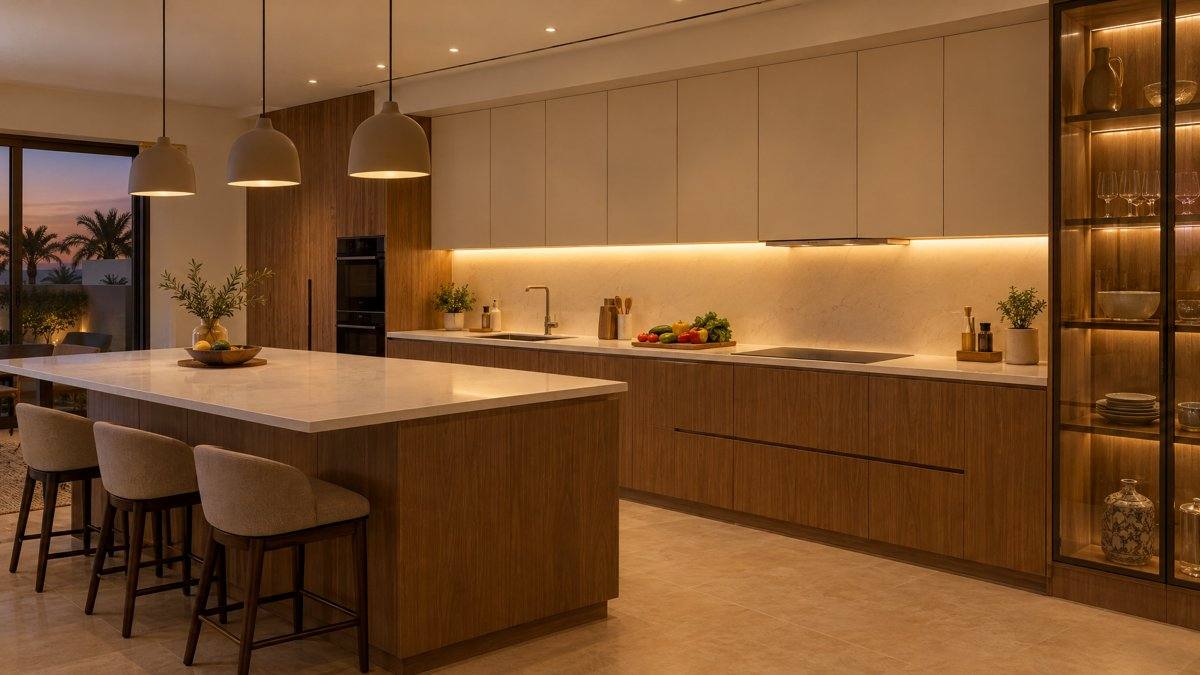
Kitchen lighting: The complete guide
A kitchen is a workspace before it is a showpiece. The best-known mistake is a ceiling full of spotlights behind you, so your own shadow falls on the chopping surface. The solution is task lighting directly above the worktops.
Recommended values
Guide values; the final design depends on the space, its colours and its use.
The most common mistake: your shadow on the worktop
The complaint we hear most often: “The kitchen is dark even though the ceiling is full of spotlights.” The reason is that spotlights in the middle of the ceiling sit behind the person standing at the counter, so their body blocks the light and casts a shadow exactly on the chopping surface. Upper cabinets add more shadow over the back of the worktop.
The solution is a separate task-lighting layer: a strip or line of light under the upper cabinets, close to the front edge, lighting the worktop directly in front of your hands.
The layers of a kitchen
| Layer | Example | Purpose |
|---|---|---|
| Task lighting | A line under the upper cabinets, or focused spotlights over the island | Chopping, cooking and reading |
| General lighting | Spotlights in a line in front of the cabinets, or linear lighting | Movement and cleaning |
| Island lighting | Pendants or a suspended linear light | Defining the island and the seating around it |
| Display lighting | Inside glass-fronted cabinets or on open shelves | Beauty and depth |
| Concealed lighting | Under the base cabinets or above the upper ones | Visual lightness and night-time light |
Under-cabinet lighting done right
- Place the line near the front edge of the cabinet, not near the wall, so it lights the whole worktop and its source cannot be seen when standing.
- Use an aluminium profile with an opal diffuser, or a continuous COB strip; on glossy marble and quartz, an ordinary strip's LEDs reflect as an annoying row of dots.
- Avoid surface mounting without a profile: heat shortens the strip's life, and steam and grease stick to it.
- Plan the Driver location and the power feed to the line before the cabinets and tiles go in; this is the most frequently forgotten point at first-fix stage.
- Put the task lighting on its own switch, preferably dimmable.
The island and pendants
- Hang pendants so their lowest point is roughly 75 – 85 cm above the island surface, so they do not block the view between people standing.
- Their number and spacing follow the island's length: two or three equally spaced pendants, or a single suspended linear light.
- A clear glass pendant dazzles the eye if the lamp is visible; choose a diffuser or a matte lamp.
- If the island is a main work surface, pendants alone are not enough; add focused spotlights or choose pendants with strong downward light.
Colour temperature and colour accuracy
A kitchen needs to show food, meat and vegetables accurately, so CRI 90 or higher is not a luxury here. Colour temperature should be 3000K – 4000K; 4000K is crisper for work, while 3000K suits a kitchen that is open to the living area.
- Most important is a consistent colour temperature across all the fixtures in the kitchen and the space open to it; mixing 3000K with 6000K makes the kitchen look like a patchwork of colours.
- If the kitchen is open-plan, Tunable White fixtures or dimming scenes allow working light by day and calm light in the evening.
Heat, steam and safety
- Near the sink and hob, choose fixtures rated at least IP44.
- Fixtures above the hob are usually built into the cooker hood; never place an ordinary spotlight directly over a heat source.
- Kitchens in Oman and the GCC see heavy use and high temperatures: choose fixtures with aluminium bodies that dissipate heat, and Drivers with a known warranty.
- Fixtures close to grease need an easy-to-clean surface without many openings.
- An outdoor or prep kitchen should be treated as outdoors: IP65 or higher.
Checklist before first fix
- The final kitchen design (cabinets, island and appliances) before the lighting is laid out.
- A power feed for under-cabinet lighting in the right position, and a place for the Driver.
- Pendant points measured from the actual centre of the island, not the centre of the ceiling.
- Separate circuits: general, task, island, display.
- A power feed for lighting inside glass-fronted cabinets, if any.
How to build the layers
- Strips under the wall cabinets above the worktops, inside a profile with a diffuser so the dots don’t reflect on the marble.
- If the surface is glossy, use a continuous COB strip or an opal diffuser.
- General spotlights in a line in front of the cabinets, not in the middle of the ceiling.
- Pendants over the island, hung at a height that doesn’t block the view.
- Lighting inside glass-fronted cabinets, if any.
Common mistakes: Kitchen
Common mistakeFluorescent colour mistake (Halophosphor)
“Your kitchen is high-end, but the lighting makes it look cheap? The problem is the type of tube!”
- The problem
- Using old fluorescent tubes (single phosphor) with poor colour rendering
- Technical explanation
- You should use modern Tri-phosphor tubes, or LED, because their colour accuracy (CRI) exceeds 80 and they give a stronger output
- The result
- An appetising kitchen, with true, vibrant food colours
Common mistakeMissing task lighting in the kitchen
“Cooking with your own shadow covering the food? Your kitchen lighting is incomplete!”
- The problem
- Relying on Downlights in the walkways and neglecting the work areas (counters)
- Technical explanation
- Task Lighting using LED strips under the upper cabinets prevents shadows and delivers 500 lux directly on the chopping area
- The result
- A safe, comfortable kitchen to work in that looks like a palace kitchen
Common mistakeMarble spoiled by LED dots
“Installed concealed lighting under a marble shelf and it shows as dots? You've ruined the luxury!”
- The problem
- The dots of the LED strip reflect on glossy surfaces.
- Technical explanation
- Glossy surfaces need a continuous dot-free strip, or an “aluminium profile” with a diffuser cover that hides the dots completely.
- The result
- Kitchen and Majlis details as perfect as in hotels.
Installation errorNeglecting task lighting in the kitchen
Forgetting to run power for LED strips under the upper kitchen cabinets to light the chopping surface.
Installation errorLighting the kitchen with a central light only
Settling for ceiling Downlights and ignoring task lighting (strips under the upper cabinets) creates shadows over the food-prep area.
Installation errorUsing 220 V strips within reach
Placing them under the lower cabinets or on shelves poses a serious risk of electric shock.
Frequently asked questions
QuestionWhy is my kitchen dark despite all the spotlights?
Because the spotlights are behind you, and your body blocks their light from the worktop. The solution is task lighting under the upper cabinets, not more spotlights.
QuestionWhich colour temperature is best for a kitchen?
3000K to 4000K with CRI 90 or higher. What matters is keeping the colour temperature consistent across the kitchen and the space open to it.
QuestionIs an LED strip under the cabinets enough?
It is enough for the worktop if it sits in a profile with a diffuser close to the front edge, but it does not replace general lighting for movement and cleaning.
Customer questionMy kitchen is dark even though the ceiling is full of spotlights. Why?
The answer: Because the spots are behind you, so your shadow falls on the worktop. The fix is task lighting directly over the counters, such as strips under the upper cabinets.
Customer questionWhat does the IP65 number on the box mean, and do I need it in the kitchen?
The answer: The 6 means fully dust-tight, and the 5 means it withstands water jets. In the kitchen, IP44 near the sink is usually enough; IP65 is required above the shower and outdoors.
Customer questionWhy do my kitchen lights make food look old or dull?
The answer: Because you're using a very cool Kelvin or a poor, single-phosphor CRI.
Customer questionWhy do I see the dots of the hidden strip reflecting on the kitchen marble?
The answer: Because an aluminium profile with a diffuser that hides the dots wasn't used.
Customer questionWhy do kitchen lights make food look dull?
The answer: Poor CRI quality; make sure you use CRI 90 or higher in the kitchen.
Comparisons and facts
Comparison3000K vs. 4000K
“Can't decide between warm yellow or natural white for your project?”
- The problem
- Choosing a gloomy colour for the façade or a harsh colour for bedrooms.
- Technical explanation
- 3000K warm yellow is ideal for classic styles and relaxation. 4000K bright white is ideal for clean modern façades and kitchens.
- The result
- Smart consistency that shows off your home's beauty correctly.
ComparisonStandard strip light vs COB LED
“Installed cove lighting under the kitchen shelf and it shows up as rows of dots? There goes the luxury!”
- The problem
- LED dots reflecting on glossy surfaces such as marble.
- Technical explanation
- COB strip uses continuous-dot technology that gives an unbroken line of light like a laser, leaving no dotted reflection on marble.
- The result
- Your kitchen's finishing details will match international design catalogues.
ComparisonDotted LED strip vs. continuous COB strip
“Your kitchen marble reflects the dots of the lights? The luxury is gone!”
- The problem
- Dotted reflections on glossy surfaces
- Technical explanation
- Glossy surfaces need either a COB strip (a continuous line of light) or an aluminium profile with an opal diffuser to hide the dots completely
- The result
- Flawless kitchen details just like international showrooms
Spec explainedIlluminance level (lux)
“How do you know your room is bright enough without guessing?”
- Technical explanation
- Lux is the amount of light falling on one square metre. Kitchens and offices need 500 lux; living rooms and corridors 100 lux
- The result
- Scientific lighting distribution that protects your eyesight and precisely suits each room’s function
FactKitchen lighting needs two layers
Ceiling lighting alone isn't enough: your body will cast a shadow on the “counter”. Lighting under the upper cabinets is a necessity, not a luxury.
References
- Lighting Research Center: Lighting Patterns for Homes
- European standard EN 12464-1: lighting levels for work surfaces and colour rendering
- IEC 60529: IP protection ratings
- Address Lighting knowledge base from villa projects and client questions
The content is adapted and developed from these references for Gulf homes, not a literal translation.